Pose Library Studio is now available. Access the full pose library and custom sessions.
Shoulder and Hip Axis Lines in Gesture Drawing
Learn how shoulder and hip axis lines help artists capture weight, balance, and movement in gesture drawing.
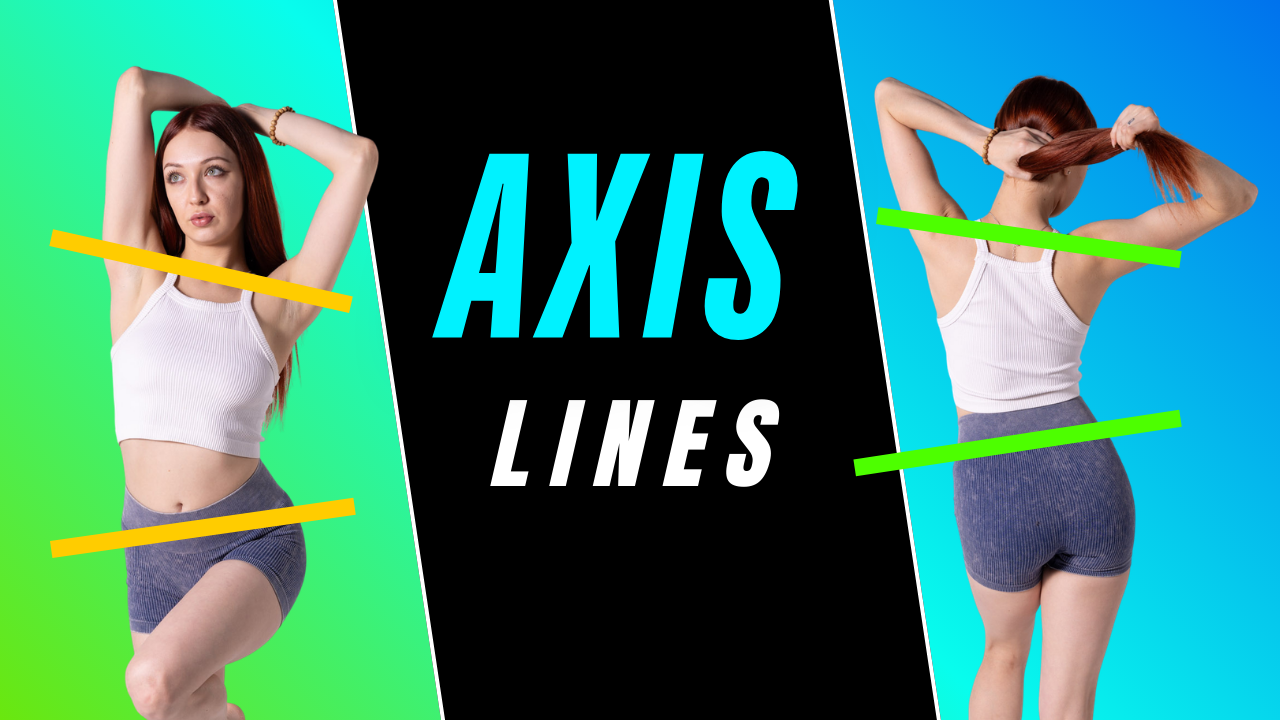
Shoulder and hip axis lines in gesture drawing are simple transverse guide lines that connect matching landmarks across the shoulders and pelvis. They help you see tilt, weight shifts, and body rhythm before you commit to anatomy or contour.
Most beginner gesture drawings have a common problem: they capture the pose, but they lose the energy.
The arm is raised. The torso is leaning. The legs are bent. Everything is technically correct. But the drawing still feels stiff.
I see this constantly when students begin learning figure drawing. The pose might be dynamic, but the drawing becomes stable and rigid.
Why does this happen?
One big reason is that artists forget to track the direction the body forms are traveling. The rib cage tilts, the pelvis rotates, and the shoulders angle in space. If we ignore these directions, the drawing flattens out.
That is where shoulder and hip axis lines come in.
Axis lines help us quickly map the tilt of the body's major structures. Instead of guessing how the torso is oriented, we draw a simple line connecting key landmarks. These lines immediately show whether the body is leaning, twisting, or counterbalancing.
When used correctly, the shoulder hip axis line becomes one of the fastest ways to bring rhythm, structure, and clarity to gesture drawing.
In this guide, we'll break down how these axis lines work, how to find them on the body, and how to integrate them into your gesture drawing process. For a broader overview of structural guide lines, read Axis Lines Explained.
If you are still building the first stage of your gesture workflow, start with line of action drawing, then add these shoulder and hip checks once the main movement is clear.
Introduction
The first time I realized my gesture drawings were stiff was during a life drawing session. I had done maybe twenty one-minute poses. I thought they looked decent. Arms were where they should be. Legs were bent correctly. Everything seemed right.
Then I looked at the model again.
And something felt off.
The pose in front of me had energy. The torso leaned. The shoulders were angled. The pelvis shifted weight onto one leg. But my drawing looked like the model had been politely asked to stand still for a passport photo.
It took me a while to understand why this happens.
Most beginner figure drawings capture positions, not direction. The arm is raised. The torso is leaning. The legs are bent. But the movement of the body through space is missing.
This is where axis lines in gesture drawing completely change the game.
Axis lines are simple guide lines that show the tilt and direction of major body masses. When artists draw the shoulder axis line and the pelvis axis line, something interesting happens. Suddenly the drawing starts to feel balanced. The pose starts to breathe.
I started adding these lines to my gesture drawings years ago, mostly because I saw other artists doing it. At first I didn't fully understand why they worked. But after a few months of practicing quick gesture sketches, it became obvious.
These lines help you understand:
- how the torso tilts
- how the body balances weight
- how the shoulders and hips oppose each other
- how movement flows through the figure
Once you start seeing shoulder and hip axis lines, you can't unsee them.
Now when I look at a pose, those two lines jump out immediately.
And if you're learning gesture drawing, they might be one of the fastest upgrades you can make to your figure drawing process. You can practice them directly in short sessions with gesture drawing practice.
What Are Axis Lines in Gesture Drawing?
Axis lines are one of those concepts that sound complicated at first, but they're actually very simple once you start using them.
Think of them as direction lines for body masses.
When we draw the human figure, we're not just drawing shapes. We're trying to understand how volumes tilt and rotate in space. The rib cage tilts. The pelvis rotates. The shoulders lean. Axis lines help us see that structure clearly. For a deeper look at those torso masses, see constructing the torso in gesture drawing.
There are two general types of axis lines used in figure drawing:
1. Central axis lines
These run through the center of a form.
For example:
- the centerline of the torso
- the centerline of the leg
- the centerline of the neck
These lines help show the orientation of a form.
2. Transverse axis lines
These run side to side across a form.
This is the type of axis line most commonly used in gesture drawing.
Examples include:
- the shoulder axis line
- the pelvis axis line
- the rib cage axis
These lines show the tilt of the body from left to right.
When I first started learning gesture drawing, I ignored these lines completely. I focused mostly on outlines. I tried to capture the contour of the body. That approach sort of worked, but something was missing.
The drawing didn't feel alive.
Then a teacher once said something that stuck with me.
He said:
"Gesture drawings are diagrams of movement, not drawings of bodies."
That sentence changed how I approached gesture drawing.
Instead of thinking about muscles and outlines, I started thinking about direction.
- Which way is the rib cage leaning?
- Which shoulder is higher?
- Which hip is carrying the weight?
Axis lines answer those questions quickly.
They're not meant to be pretty. They're not anatomy drawings. They're simple construction lines that explain the pose.
And weirdly enough, the simpler they are, the more useful they become.
Find the tilt of the shoulders and hips
Focus on angle, balance, and opposing directions
5 x 30-second poses
No signup required.
Finding the Shoulder Axis Line
The shoulder axis line is one of the easiest axis lines to locate once you know what to look for.
It simply connects the two sides of the shoulder girdle. That's it.
But the trick is knowing which points to use.
A very helpful set of landmarks are the lateral ends of the clavicles, which are the outer ends of the collarbones. These small bony points sit near the top of the shoulders and can often be seen or felt beneath the skin.
If you run your fingers along your collarbone toward your shoulder, you can usually feel that outer end where the bone meets the shoulder structure. That spot becomes one of the most useful reference points when locating the shoulder axis.
When drawing from a model or pose reference, the process usually looks like this:
- Identify the left shoulder landmark
- Identify the right shoulder landmark
- Connect them with a straight line
That line becomes the shoulder axis line.
Simple.
But here's where beginners often make a mistake.
They assume the shoulders are horizontal.
They aren't.
Almost every natural pose has some kind of shoulder tilt. Sometimes the angle is subtle. Other times it's dramatic. If you flatten that line in your drawing, the pose instantly loses energy.
This happened to me constantly when I first practiced gesture drawing. I would draw the shoulder line too level. It felt safer somehow.
But the pose would look stiff.
Now I try to exaggerate the tilt slightly during gesture practice. It helps the drawing stay dynamic.
Also, there are times when the clavicles are hard to see. Arms might be raised. Hair might cover the shoulder. Lighting might hide the landmarks.
When that happens, just pick two matching points on each shoulder and connect them.
The goal isn't perfect anatomy. The goal is understanding the direction of the shoulder plane.
Once you start doing this consistently, you'll notice how much information that one simple line communicates.
Finding the Hip Axis Line
The pelvis axis line is just as important as the shoulder axis line. In fact, many gesture drawing teachers would argue it's even more important because the pelvis controls the body's balance.
The pelvis carries the weight of the torso and connects to the legs. When a person shifts weight onto one leg, the pelvis tilts. That tilt affects the entire figure.
To find the pelvis axis, artists often look for two specific landmarks called the anterior superior iliac spines, often shortened to ASIS. These are small bony points located on the front of the pelvis and they can sometimes be seen pushing slightly against the skin.
If the model is facing you, these points usually appear near the front of the hips.
The process is similar to the shoulder axis:
- find the ASIS on the left side
- find the ASIS on the right side
- connect them with a line
That line becomes the pelvic axis line.
When drawing the back of the body, another set of landmarks can help. These are called the posterior superior iliac spines, or PSIS. On many people they appear as two small dimples in the lower back.
Those dimples can act as excellent reference points for locating the pelvis tilt from behind.
Now here's something interesting.
In many natural standing poses, the pelvis axis tilts in the opposite direction of the shoulder axis.
For example:
- right shoulder raised
- left hip raised
This creates a visual rhythm in the body that artists often refer to as contrapposto.
Once you start seeing that opposing tilt, gesture drawing becomes easier. The pose suddenly feels organized.
Without the pelvis axis, I used to struggle with weight shifts in my drawings. Everything looked evenly balanced even when the model was clearly leaning.
Adding that one line solved a lot of those problems.
How Shoulder and Hip Axis Lines Create Dynamic Poses
One of the coolest things about studying shoulder and hip axis lines is realizing how much movement exists in a simple standing pose.
When beginners draw figures, they often treat the body like a stack of blocks. Head on top. Torso below. Pelvis under that. Everything lined up neatly.
But the body doesn't really work that way.
When someone shifts weight onto one leg, the pelvis tilts. The spine curves to compensate. The rib cage rotates slightly. The shoulders tilt in response.
These opposing angles create a visual rhythm through the body.
In gesture drawing, the relationship between the shoulder axis and the pelvis axis becomes a quick way to understand the entire pose.
Standing weight shift
- pelvis tilts upward on the weight-bearing leg
- shoulders tilt opposite direction
- spine curves between them
Leaning pose
- both axes may tilt in the same direction
- torso compresses on one side
- torso stretches on the other side
Dynamic action pose
- axes may be steep angles
- shoulders rotate dramatically
- pelvis shifts forward or backward
When I first started studying gesture drawing seriously, I noticed something interesting in good drawings.
Artists rarely drew shoulders and hips perfectly level.
Almost always there was a clear tilt.
And when that tilt was captured correctly, the drawing instantly felt more alive.
Axis lines are basically shortcuts for identifying that tilt.
Instead of guessing how the torso is oriented, you just draw the lines.
It's quick. It's simple. And it works.
Add structure with axis lines
Clarify shoulder and hip relationships and build stability
5 x 1-minute poses
5 x 2-minute poses
No signup required.
How to Use Axis Lines in Gesture Drawing
Axis lines are most useful when they are part of a simple gesture drawing workflow.
Over time, most artists develop their own order of operations. But a common approach looks something like this.
Step 1: Draw the primary line of action
This is the main movement of the figure.
It might run through:
- the spine
- the torso
- the entire body
This line establishes the overall flow of the pose.
Step 2: Add secondary gesture lines
These capture the movement of major limbs.
For example:
- a leg curve
- an arm direction
- the tilt of the torso
Step 3: Add the shoulder axis
Connect the two shoulders with a straight line.
Don't worry about anatomy detail. Just capture the tilt.
Step 4: Add the pelvis axis
Locate the hips and draw the line connecting them.
This shows the weight shift immediately.
At this stage the drawing still looks like a diagram. That's normal.
Gesture drawings are not finished figure drawings. They are movement maps.
Sometimes the lines overlap. Sometimes corrections are drawn right over earlier lines. That's part of the process.
In fact, some of the best gesture drawings look messy.
But underneath that mess is a clear structure built from a few simple lines:
- line of action
- shoulder axis
- pelvis axis
Those three elements alone can capture the essence of a pose.
Frequently Asked Questions
What are shoulder and hip axis lines in gesture drawing?
Shoulder and hip axis lines are simple transverse guide lines that connect matching landmarks across the shoulders and pelvis. They show how the upper body and hips tilt, balance, and counterbalance in a pose.
Where do you place the shoulder axis line?
Place the shoulder axis line by connecting matching shoulder landmarks. The outer ends of the clavicles are useful landmarks when they are visible, but in quick gesture drawing you can estimate the line by matching points on each shoulder.
Where do you place the hip or pelvis axis line?
Place the pelvis axis line by connecting matching hip landmarks. From the front, artists often use the ASIS points. From the back, the PSIS dimples can help show the pelvis tilt.
Why do axis lines make gesture drawings more dynamic?
Axis lines make gesture drawings more dynamic because they reveal tilt, weight shifts, and opposing angles between the shoulders and hips. Those relationships help the figure feel balanced, directional, and less stiff.
Conclusion
Gesture drawing is about capturing energy.
But energy in drawing doesn't come from details. It comes from direction and structure.
The shoulder axis line and pelvis axis line give artists a fast way to understand how the body tilts and balances in space. These simple lines help reveal weight shifts, torso rotation, and the rhythm that flows through the entire figure.
Once you start adding axis lines to your gesture drawings, something interesting happens. The poses begin to feel more believable. The movement becomes clearer. The drawing starts to communicate the pose instead of just copying it.
A simple practice routine can help build this skill quickly:
- draw one-minute gesture poses
- begin with a line of action
- add shoulder axis
- add pelvis axis
Do this for twenty poses in a row.
After a few sessions, your eye will start spotting these axis lines automatically. And once that happens, gesture drawing becomes much easier.
You're no longer guessing the pose.
You're understanding it.